RECOMMENDED READING: Rare rocks? The truth about Rolex meteorite dials
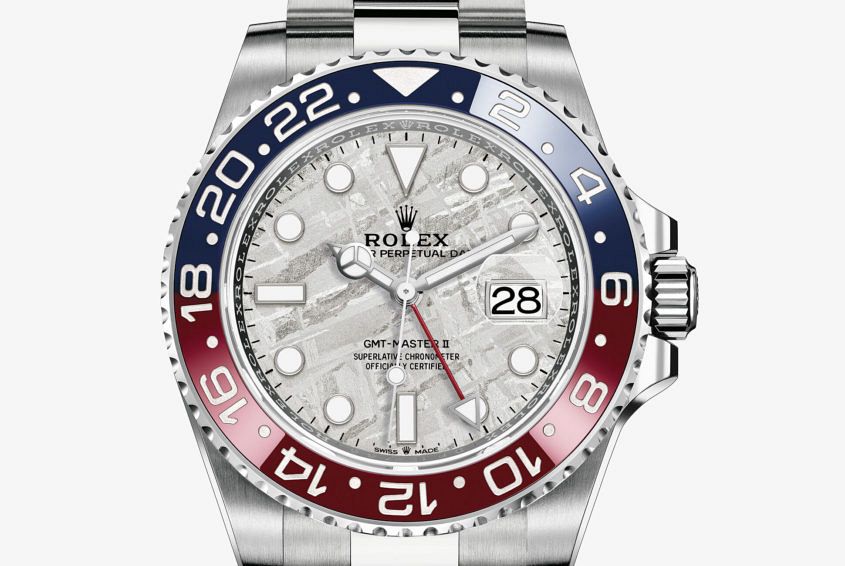 It isn’t every day you look out the window and see a meteor shower. In fact, it’s a newsworthy event when anyone is lucky enough to catch one on film. So I don’t think you would be going out on a limb to say that they are fairly uncommon events, causing you to assume that meteorite is a pretty rare mineral to come by, and it must be very expensive. How then are so many watch companies producing timepieces with meteorite dials? One of the most talked about watches from Baselworld 2019 was a white gold Rolex GMT-Master II with a meteorite dial, the distinctive geometric patterns on the thin slice of rock making for an attractive watch. But the question that came to some people is where do Rolex meteorite dials come from? The folk at Gear Patrol were also perplexed by this set of circumstances, so they did a little digging to find out more and published what they found here. As it turns out, there are a few challenges in working with this exotic material.
The post RECOMMENDED READING: Rare rocks? The truth about Rolex meteorite dials appeared first on Time and Tide Watches.
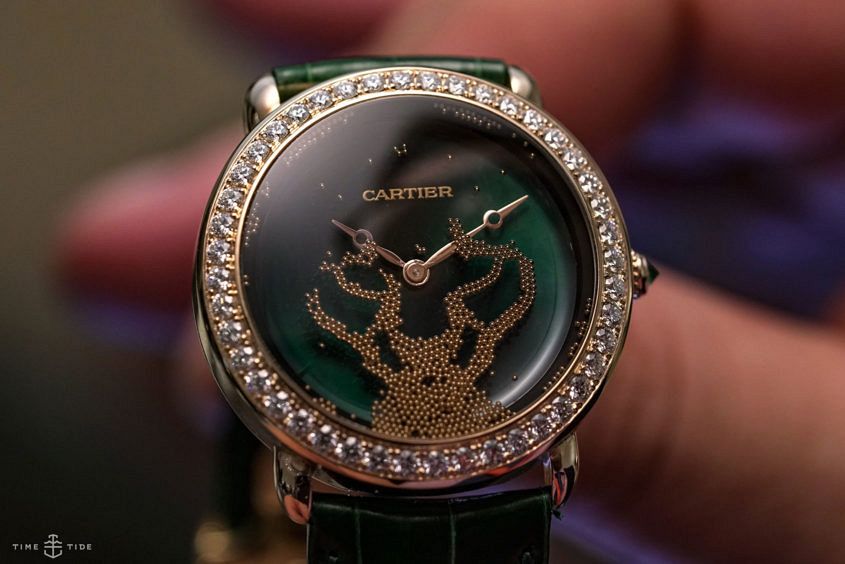 Here at Time+Tide HQ, the banter is fast, free-flowing and deeply uninteresting for anyone who doesn’t love watches. Sometimes this spitballing makes it beyond our four humble walls, such as when the team built a fantasy $20K watch collection, and this is another one of those occasions. The question posed to the team this time: “If you had to wear a watch marketed at a different gender, what would it be?” This isn’t to say that people can’t wear whatever watches they want (I love wearing a watch which could be argued is a women’s watch), but is just taking the lead from the brands’ positioning of their products. Here we go! Andrew (Jefe) – Piaget Limelight Gala The design of the lugs is just beautiful and creates a sort of flow to the case. The hammered gold bracelet is also spectacular and painfully handcrafted, too. In every way this is a considered watch, rich in nuance. Felix (Editor) – Chanel Boy.Friend Skeleton Chanel is becoming an increasingly impressive player in the “proper watch movement” space. And while the gorgeous from the bottom-up build of this movement is enough to win you over, I actually love the chic style. Plus,…
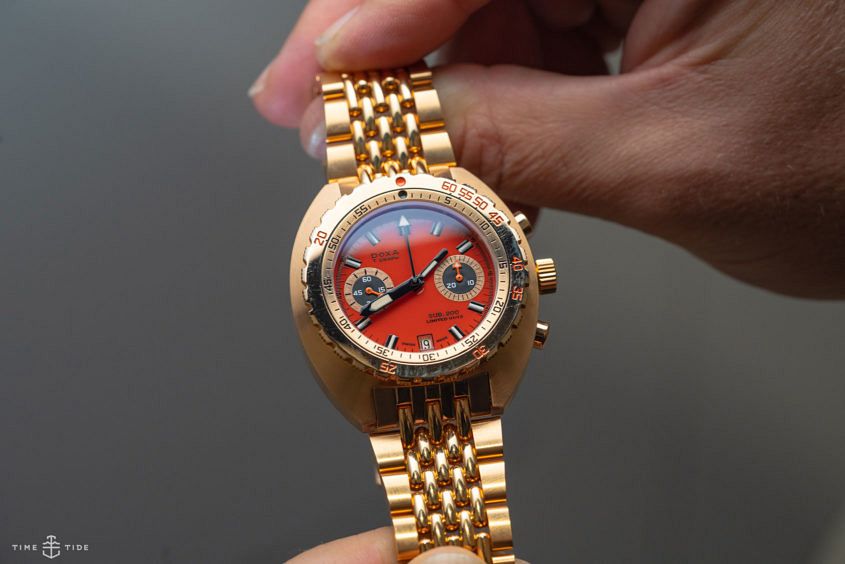 One of the most random, and awesome watches to emerge from the briny depths of Baselworld was the (very) limited edition Doxa SUB 200 T. On the surface this is a pretty standard vintage reissue, with a big 43mm case in that classic cushion shape, with that classic orange dial, in a dual register layout (powered by a hand-wound Valjoux 7734), and with some awesomely retro dial details — blocky prints, stocky hands, the whole nine yards. But — and this is a big but — the case is made from solid-freaking-yellow-gold. Solid, with a capital S O L I and D. And did we mention the fact that it’s an LE of 13 pieces? If you want wrist presence, this is pretty much the definition. It’s also the definition of odd flex. I’m not sure the world needed a $70K USD gold Doxa (worth noting here that a solid gold Rolex Daytona is around $45K AUD), but it’s kind of a better place for it. Maybe?
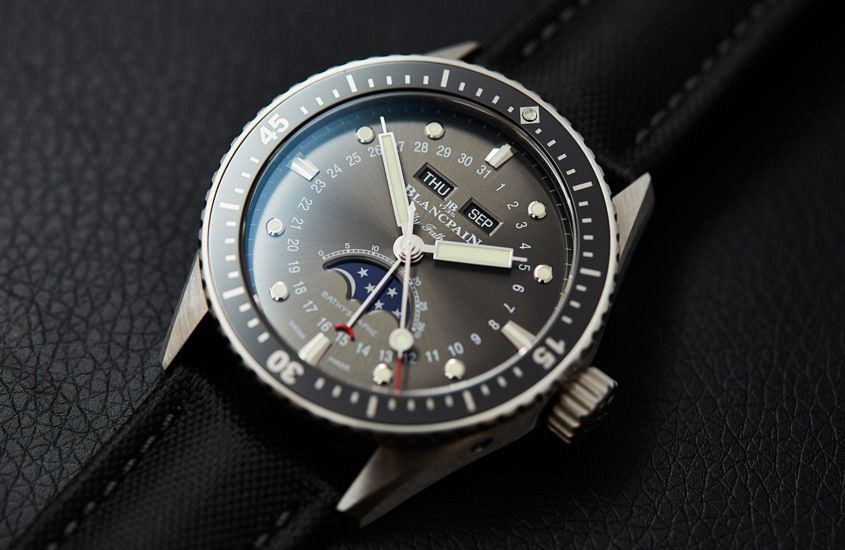 Editor’s note: Dive watches tend to be simple affairs, but not always. Justin embraces complexity (and calendars) in his review of the Blancpain Bathyscaphe Quantième Complet Phase de Lune. Read on … The story in a second: A classy calendar for the life aquatic. Expanding on a dive watch collection — especially one with such a rich history as the Blancpain Fifty Fathoms — is a challenge at the best of times. Do you stick to classic tool watch roots? Do you step outside the box with a complication or design with more commercial appeal? Do you start toying with unorthodox case materials? There are a lot of ways to go here, and as we’ve seen year after year, the results can be fantastic, just as easily as they can be questionable. We’ve seen Blancpain take some interesting approaches with the Fifty Fathoms Bathyscaphe collection recently, including the blue ceramic-cased flyback chronograph Ocean Commitment II, but for 2018 we were presented with a couple of very unexpected dive watches from the longstanding brand. The most curious is the complete calendar moonphase (Quantième Complet Phase de Lune, per the brand), taking the classic 43mm satin-brushed Bathyscaphe case, and fitting it with…
 It’s long been a staple of watch collecting advice and lore — don’t keep your watches in your sock drawer or consumer-grade safe, keep them in a safe deposit box. Well, that old adage is looking a little stretched on the basis of a recent article in The New York Times, which recounts the harrowing tale of a watch collector who rocked up to his bank one day to discover his collection of watches gone. And it wasn’t the result of a daring heist, instead the much more banal human error. Even worse, he had precious little legal recourse or protection. An excellent look at one of the most romanticised, and least profitable aspects of banking … Well worth a read.
  Next up in our rolling cavalcade of ‘Every Watch Tells a Story’ stories is Vince. Now, this one is a bit of a funny one, and not just because the watch in question is the critically acclaimed Joker from Russian watchmaker Konstantin Chaykin. If you’re not familiar with the Joker, it’s a very clever piece of watchmaking, that looks like, well, a Joker. Look closer and you’ll notice that those crazy eyes show hours and minutes, and the lolling red tongue is actually a moonphase. It’s bright, cheery and pretty out of the box for a generally conservative industry. And these are all reasons why Vince fell for the watch, hard. The only problem? It was limited to 99 pieces and they were all gone. He actually made a secret edition with a casino in Russia called Tigre de Cristal So Vince put some calls in to try to track one down. Within minutes he had a call back … but there was something odd about this Joker …
 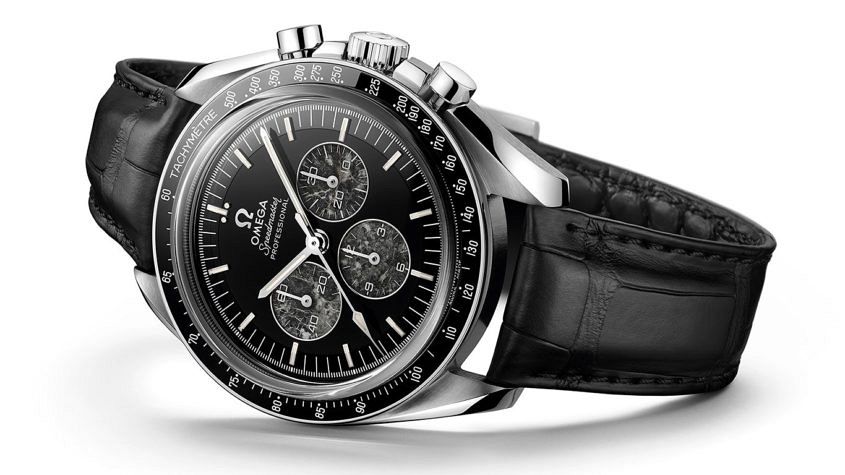 Watch lovers across the planet have been collectively holding their breath this year, eagerly waiting for Omega to release a commemorative watch to celebrate humanity launching away from the planet. It was 50 years ago that American astronauts left the safety of their lunar module and stepped onto the surface of the Moon, with Omega Speedmasters strapped to their wrists. The Moon landings were the most viewed event in human history, with an estimated 650 million people around the world watching Neil Armstrong take a giant leap for mankind. Needless to say, Omega hasn’t forgotten its involvement with the mission, and are celebrating the 50th anniversary with the Omega Speedmaster Moonwatch 321 Platinum. There’s a lot to love about this watch, so we wanted to count down our three favourite parts of the new 321. 3 – The movement The calibre 321 began development in 1942 by Lémania movement designer Albert Piguet, who also worked on movements for Omega (as they were both owned by the Swatch Group). It was first used in the Omega Speedmaster in 1957, and finally ceased production in 1968 when it was replaced by the calibre 861 chronograph movement. Raynald Aeschlimann, CEO of Omega, hinted…
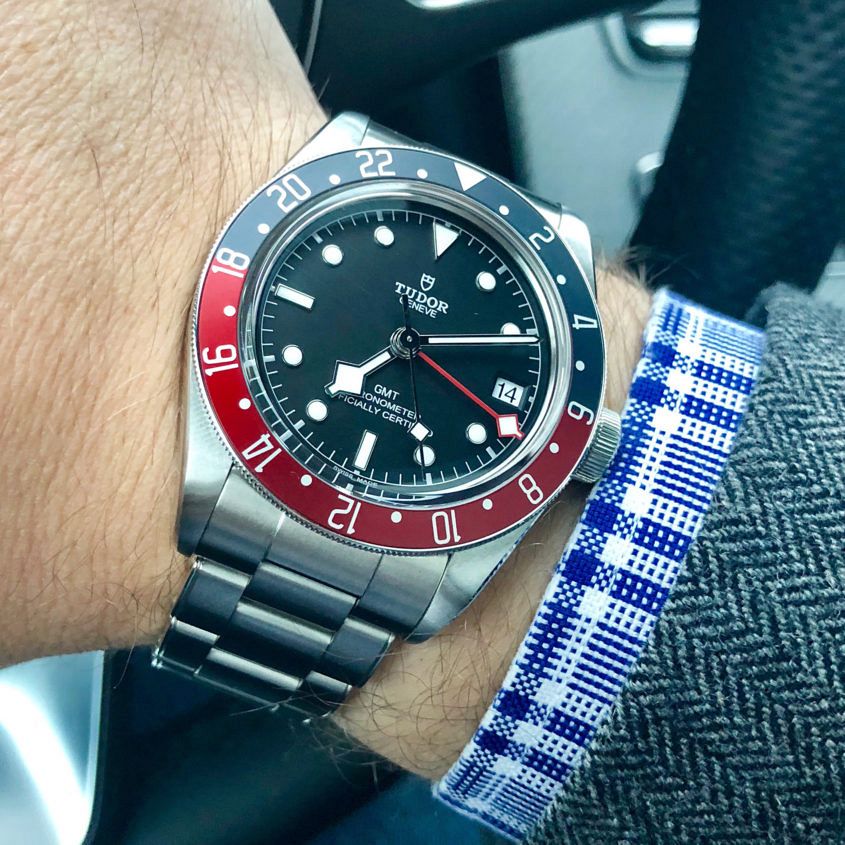 Editor’s note: Bruce doesn’t write for us too much, but when he does, it’s absolute gold. From his classic Batman review to this extended wear of the Tudor Black Bay GMT. A great, insightful take on one of the hottest pieces in the market right now. When the Tudor Black Bay GMT debuted this year at Basel it would’ve been easy to describe it as being overshadowed by the much-hyped Rolex GMT that was also showcased. But it’s not that simple. The Tudor is a hit in its own right, and I knew I had to have one. I had to wait half a year before I could get my hands on one and I can safely say that Tudor has once again reinforced their reputation as a brand to watch. My first impression was … that it might be too big and therefore uncomfortable. The 41mm case, water resistant to 200m, which houses the amazing new manufacture MT5652 movement, is very thick, at 15mm top to bottom. I found the clever folks at Tudor have worked some subtle angles underneath the case sides and tapered the lugs in such an elegant fashion that the Black Bay GMT actually wears smaller…
 For as long as time has been indicated with hands on a dial, horologists have been hunting for different ways to communicate time. Contemporarily, this pursuit has taken some weird and wonderful forms, resulting in a few very clever feats of engineering to tell you what time it is. For those who are tired of tracking rotating spokes around a circle, who want something simpler (or more complex), these are the watches for you. Employing discs, screens, apertures and even revolving orbs, this is our shortlist of the best watches without hands from 2018. G-SHOCK GMWB5000D-1 35TH ANNIVERSARY SILVER ALL METAL MASTERPIECE Brainchild of Casio engineer Kikuo Ibe, the G-Shock DW-5000 was first introduced in 1983. And to celebrate the 35th anniversary of the legendarily tough resin-cased watch, the Japanese brand have introduced this version – which also happens to be the very first all stainless-steel 5000 series G-Shock. It supports all the standard functions, from a tough rectangular case and solar charging to Bluetooth connectivity. Ref No. GMWB5000D-1, Case size 49.3mm, Case material Steel, Movement Tough solar, Price $949 IWC TRIBUTE TO PALLWEBER EDITION “150 YEARS” Think “digital watch” and most minds instantly turn to thoughts of LED screens…