Slim kings – the Piaget Altiplano 40mm Ultra-Thin Date and the Altiplano Chronograph
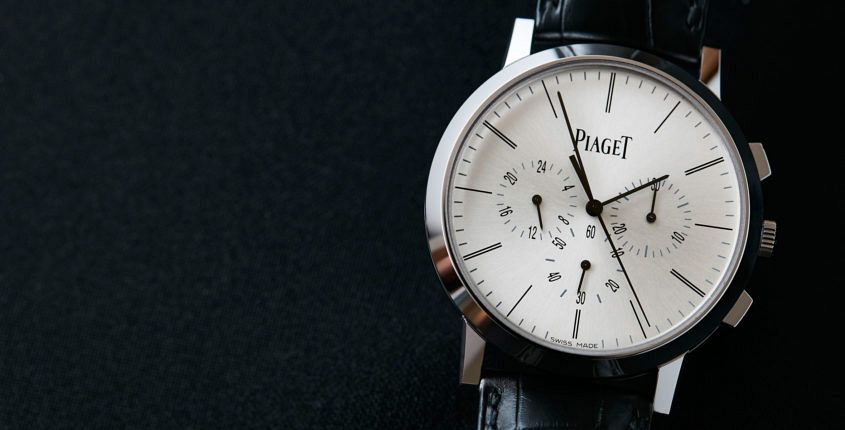 A few weeks ago we were treated to an evening with Piaget, and their thintastic Altiplano collection. And while we had a bunch of watches in our office, and our excellent photographer Jason Reekie on hand, it would have been a shame not to make the most of it. We’ve already seen what the mighty meteorite dial looks like in crisp focus under good lights, and now it’s time for two others — the 40mm Altiplano Date and the Altiplano Chronograph. Piaget Altiplano Chronograph Flyback Dual Time OK, so if you’re anything like me, a chronograph isn’t the first thing that comes to mind when you think of Piaget, or indeed of ultra-thin watches. But here we are. And here is Piaget’s take on what’s typically a très sporty watch. First seen in 2015, the Altiplano Chronograph — here in white gold — is impressive, not just for its delicate proportions (41mm wide and only 8.24mm thin for the fully cased watch; the movement is a mere 4.65mm), but also for the fact that this is a new, from-the-ground-up movement, and a manually wound column wheel flyback with a GMT at that. Technique aside, this thing is gorgeous. Clean and stylish…
The post Slim kings – the Piaget Altiplano 40mm Ultra-Thin Date and the Altiplano Chronograph appeared first on Time and Tide Watches.
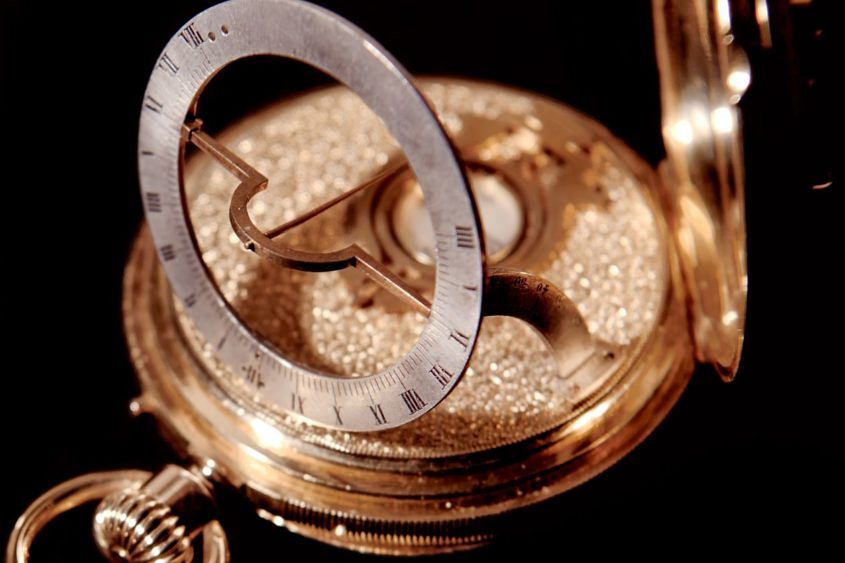 What do collectors really look for when they are already at the top of the watch game? Rarity? Provenance? Complexity? All are true for different collectors, with some placing value on the design of a timepiece, and others on condition. This variety is what keeps it interesting in the stratospheric peaks of the collecting world, where money is no object and the hunt is the source of the thrill. For collector Leon Botstein, president of Bard College and orchestra conductor, his interest lies in both pocket watches and wristwatches that were produced without the aid of computers. He describes his collection of watches as “amazing works of art”, ranging from the 19th century to the 1960s, when technology began to unwelcomely intrude in the production process. For him, the beauty of a piece lies in the complexity of its functions, and the history of a watch that shows it was once a tool of practical day-to-day use. He also shares an uncommon sentiment, that the drop in pocket watch values is “scandalous”, which forced him to consider wristwatches, when his passion was clearly held in the hand. Quoted in an article by Barron’s, Leon Botstein also discusses the modern watches…
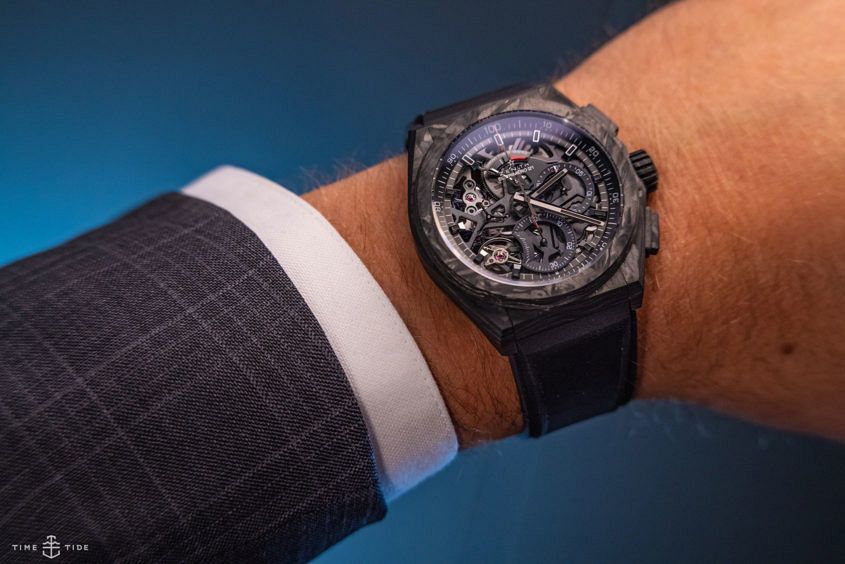 In the early years of the 21st century, Zenith was a brand that looked to the past — honouring their iconic El Primero in its original guise, and taking flights of nostalgic fancy with its Pilot’s collection. All fine watches, but comfortable takes on familiar forms. In 2017, the brand abruptly changed direction, with a thoroughly modern iteration of an old name — Defy — taking centre stage. One of the pillars of this new Zenith vision was the El Primero 21 (a watch we looked at in some detail here), which took the iconic high-frequency chronograph that is the El Primero and rocketed it to the next level. You see, the regular EP runs 5Hz, allowing 1/10th of a second accuracy. The chronograph on the El Primero 21 runs at a boggling 50Hz, meaning that the chrono hand makes a single revolution in a second, and offers 1/100th of a second accuracy. Of course this rate only applies to the chronograph operation; timekeeping runs at a more sedate and less power-hungry 5Hz, which is plenty accurate for day-to-day timekeeping. This year we were treated to a new take on the Defy: the 44mm case is offered here in carbon,…
 For decades, the Seiko 5 collection has been some of the best-value mechanical watchmaking on the planet. The ability to buy an automatic watch with an in-house movement for only a few hundred dollars must be responsible for introducing tens of thousands of people around the world to watches. You would be hard-pressed to find many watch collectors out there who haven’t owned a Seiko 5 at one point in their collecting journey. And while many of the big Swiss brands would hate to admit it, the watch industry is a much better place for the existence of the Seiko 5. It is with great excitement then, that Seiko have announced the relaunch of the Seiko 5 Sports Models, with a brand new logo and collection. The new logo is an amalgamation of the “S” in sports, and number “5”, a number specifically used for the requirement of every model to feature the following: a day-date display at the three o’clock position water resistance an automatic movement durable case and bracelet and a recessed crown in the four o’clock position With a list of minimum requirements like that, at the price point of the Seiko 5 it’s very easy to…
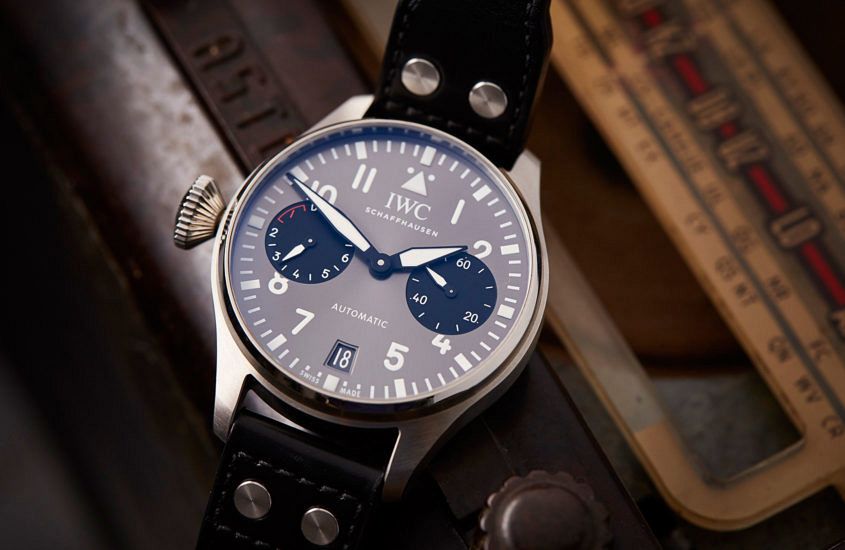 Editor’s note: Ergonomics have always been at the forefront of design for the IWC Big Pilot, with the large legible dial and oversized onion crown perfect for low-light cockpit conditions, and use with flight gloves. Despite this, it was a significant move when IWC took the design to a new place, with the Big Pilot Edition ‘Right-Hander’. It now features the crown on the left-hand side of the case, to avoid uncomfortable digging into the back of the hand or wrist. While we are still digesting this design update, we wanted to look back at the Big Pilot that started it all, and the cult status that it commands around the world. When IWC released their Big Pilot (reference 5002, now updated to reference 5010) in 2002 they were pioneers in the big watch game and they could hardly have known what legend they were creating. At 46mm it was a beast, an irresistible force. The deceptively simple design and concept is one that has been imitated, but never bettered. The Big Pilot makes a Big Statement, and over the years has attracted some big-name wearers. Orlando Bloom Orlando – A longtime IWC and Rolex fan (he’s often spotted with…
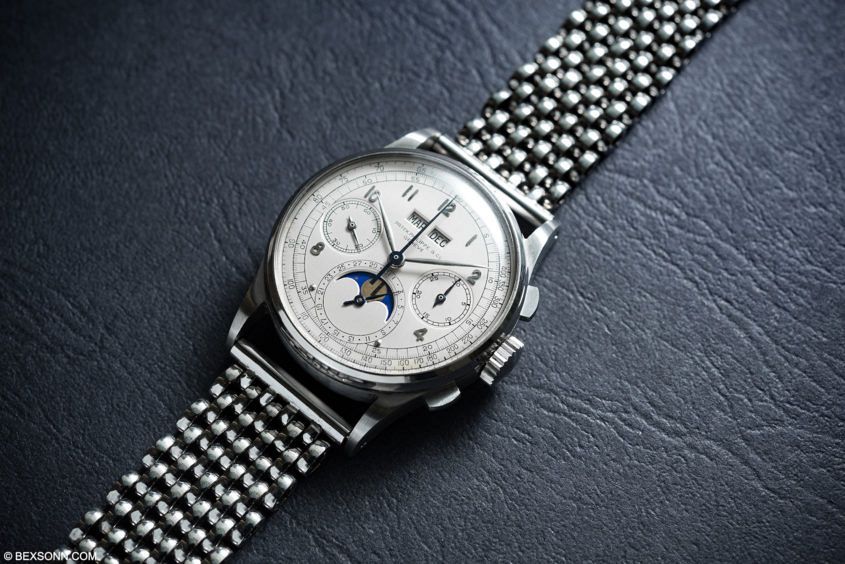 Alfredo Paramico doesn’t look like a watch collector. Living in Miami Beach, he looks more like an action hero, tanned like Baywatch and ripped like Schwarzenegger, and clad from head to toe in the latest designer capsules. However, in spite of this initial Wooster-esque impression, he is in fact one of the most well-known collectors of vintage watches in the world. A former merchant banker turned investor and watch dealer, he has amassed a collection worth an estimated $25 million. An offshoot of his own collecting behaviour is Elite Advisers, an investment fund devoted to collectible watches that are expected to appreciate. In an interview with Luxury Society in 2017, Alfredo Paramico discusses his fund in some depth, what he looks for when building his collection, and if there is a bubble in the vintage watch market. These comments are interesting in the context of what has happened to both the pre-owned and primary watch markets over the last 18 months, with certain models exploding in value for both markets. While the watch industry has changed more generally through these areas of growth, a collector of Alfredo Paramico’s calibre expresses a perspective that captures the mood of the moment.
 Jonathon did not buy this watch — a stylish Jaeger-LeCoultre Master Geographic — instead, he managed to convince his grandfather to relinquish it. It was the first watch Jonathon remembers seeing and noticing that it was a *nice* watch (and honestly, it’s easy to see why). Now, it’s one thing to notice your grandfather’s watch and admire it from afar, but it’s another thing entirely to fully migrate it from his wrist to your own. But as we discovered in the latest instalment of Every Watch Tells a Story, Jonathon’s approach was surprisingly direct. I said to him, “Hey, that’s a nice watch, I don’t see you wearing it that often — I’d be very happy to take it off you and wear it for you. And he was like … sure, if you’ll wear it more, it’s yours.” The coda to the story, though, is that the watch needed a service, and with that came a case polish, which meant that the dings and marks of a life well-lived disappeared, and while Jonathon was initially disheartened at this erasure of identity, in the end he came to the realisation that it’s now his watch, and one he can put…
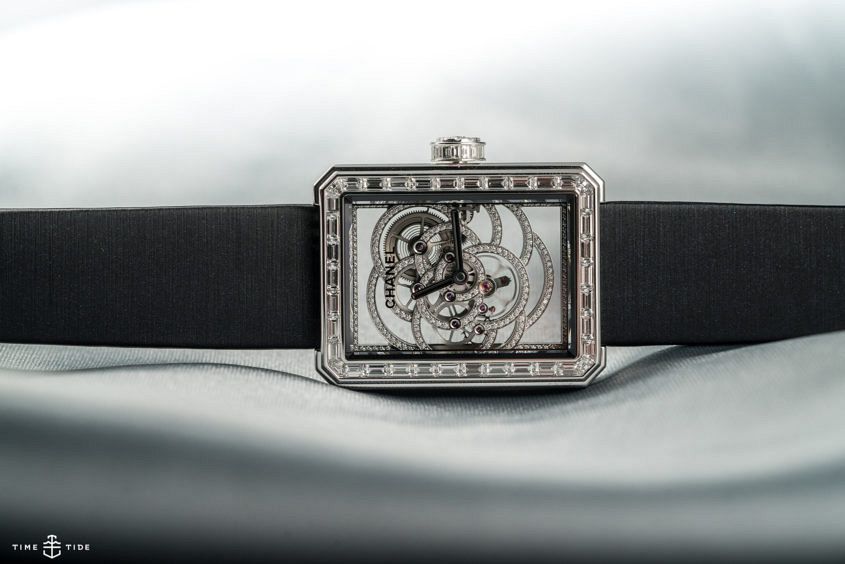 Editor’s note: Chanel has been making watches for a little while now, but in recent years they’ve been rocketing up the cool, and the credibility stakes. But this spirit of change and commitment doesn’t emerge from a vacuum, as Sandra discovers … It’s a paradox that a luxury house as conspicuously feminine as Chanel should always have had a gender-bending streak. So here comes a quick bit of fashion history – and before you watch geeks roll your eyes and change the channel, let me say that this will help explain everything about Chanel’s watches. Including why they are not to be dismissed as mere “fashion watches”. I’ll be brief. By the simple fact of launching herself into business (as a milliner) in 1910, Gabrielle ‘Coco’ Chanel flew in the face of expected gender roles. As she added clothes to her repertoire, she appropriated masculine elements: using jersey fabrics (previously reserved strictly for men’s underwear); putting chic women into trousers, and into the striped jumpers of Breton sailors; turning masculine tweeds into feminine jackets; and making suntans fashionable (previously, only outdoor labourers got tanned). The perfumes, too, always had an air of not-quite-conventional femininity; since the beginning (No.5 was launched…
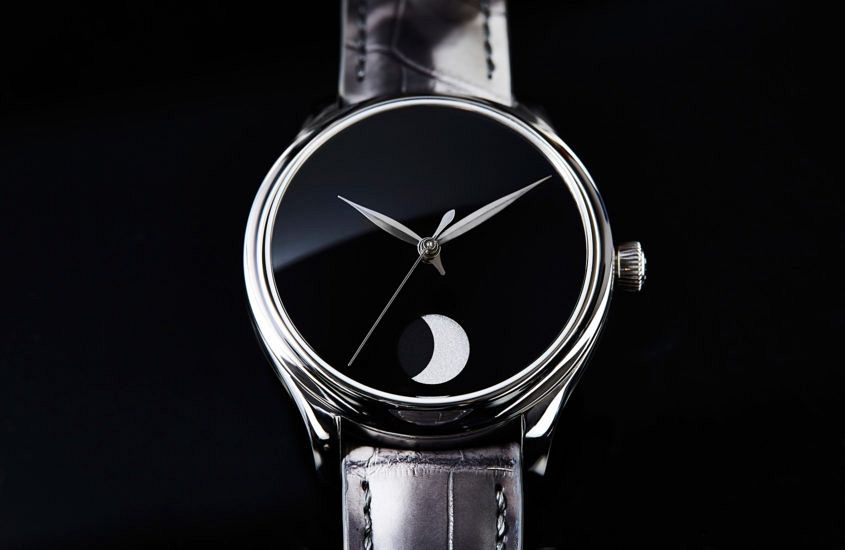 Editor’s note: Without doubt, the most popular dial colour for men’s watches is black. So, here’s the blackest, darkest dial we can think of — the H. Moser & Cie Endeavour Perpetual Moon Concept. To find out why this watch is so impossibly dark of dial, read on … Few colours have the symbolic weight of black. It’s meaningful in pretty much every culture. It’s associated — naturally enough — with darkness, mourning and solemnity, and with endings and beginnings. It’s also a colour of power and authority. All these associations and emotions are tied up in Moser’s latest conceptual piece, the Endeavour Perpetual Moon Concept Vantablack. Before we get to the greater meaning of this watch, let’s talk about the purely physical: steel case, 42mm wide, in the characteristically scalloped Endeavour case. A broad exhibition caseback shows off the HMC 801, manually wound, equipped with Moser’s interchangeable escapement and good for seven days of wind as shown on the indicator on the caseback. The strap is black alligator. All this has been seen before. What hasn’t been seen is the dial. Black, and stunning in its absence. Four hands sit upon a void of nothing. Hours, minutes and seconds…
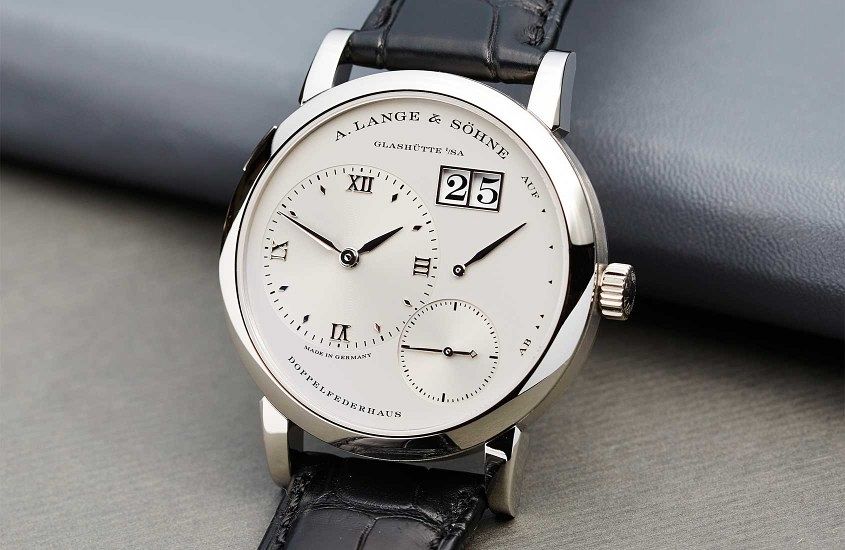 Editor’s note: In 1994, A. Lange & Söhne released a watch that would go on to be one of their most recognisable designs to date. The Lange 1 is an expression of what the brand does best: manufacturing a dial layout that is less than traditional, but with a tension in its design that suggests it is the product of decades of refinement. A masterful balance of introducing new ideas while using a level of refinement that implies rich history. Let’s take another look at this example of poised asymmetry. The story in a second: Lange give their icon a serious update. When it was first unveiled in 1994, no one had seen a watch quite like the Lange 1, with its distinct, geometrically harmonious dial. In subsequent years, the Lange 1 came to define the German brand’s pure aesthetic and impeccable technical pedigree. A resolutely contemporary looking watch, it might be surprising to learn that its roots were far from modern. In fact, it dates back to 1841, when Ferdinand A. Lange completed an innovative digital five-minute clock for the Semper Opera House in Dresden. It was this historic clock that served as the inspiration for the Lange 1’s…