RECOMMENDED READING: This is what happens when you take apart the ultra-thin Bulgari Octo Finissimo chronograph
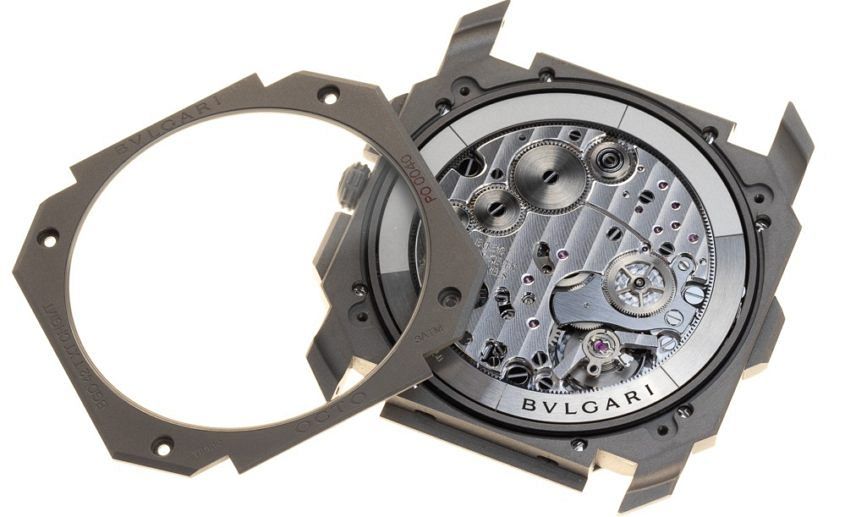 The Naked Watchmaker is one of our favourite internet projects, and not just because of its punny name and the fact that the man behind it, Peter Speake-Marin, is one of the nicest people in the business. No, it’s fascinating because it offers a view of watches we don’t typically see. Deconstructed, and not in an “I dropped it onto a concrete floor and now it’s all deconstructed” sense. No, Speake-Marin offers a superbly qualified take on taking apart a watch. And this time around he’s turning his tools to one of the hottest watches of 2019, the Bulgari Octo Finissimo Chronograph GMT. You can read our take on it here, but we stick mostly to the surface level. Read it all here. You won’t want to miss this one.
The post RECOMMENDED READING: This is what happens when you take apart the ultra-thin Bulgari Octo Finissimo chronograph appeared first on Time and Tide Watches.
 Editor’s note: Sinn is a brand that is about the best in the business when it comes to nailing affordable profession-specific watches, the most obvious of which are divers and pilots. The common denominator for both jobs is a requirement for tools that are unwaveringly reliable in their performance. This is something that Sinn are renowned for, in their ability to produce watches that are incredibly hard-wearing, made from materials that have lifespans beyond that of their owners. Let’s take a look back at one such pilot’s watch, the Sinn 104 St Sa I W. Famous for their formidable and over-engineered designs — which range from technically advanced mission timers to hardcore divers made of submarine steel — Sinn are arguably the most renowned tool watch manufacturer in the industry. However, the German company also hosts a suite of dressier pieces that are better suited to a boardroom than a war room. Meeting somewhere in the middle is the Sinn 104. A professionally capable pilot’s watch that is equally at home outside of the cockpit – be it in the office or on the street. And at the beginning of this year, Sinn added to the 104 collection with a revised…
 In its fifth iteration, the Patek Philippe Watch Art Grand Exhibition will be hosted in Singapore for the first time. Placed to emphasise the importance of Southeast Asian clients and collectors for Patek Philippe, the show will offer public insight to a number of the artefacts that typically remain in Geneva at the Patek Philippe Museum. The show will also launch a series of rare handcrafts and special-edition watches inspired by the artistic expression of the region. The show will be hosted free of charge in an 1800-square metre space at the Marina Bay Sands Theatre in Singapore, divided into 10 rooms that each display a part of the history of Patek Philippe, as well as the current collection. There will also be a number of Patek Philippe watchmakers and artisans who will show their skills in live demonstrations, offering a rare show of specialist talents to attendees. To further recognise the city in which the exhibition is taking place, there will be a collection of Patek Philippe timepieces on display that represent milestones in the history of Singapore, starting from the arrival of Sir Stamford Raffles. On loan from the Patek Philippe Museum in Geneva will be two collections…
 Watch collecting has never been more present in the public consciousness. Before the quartz revolution of the 1970s, the idea of collecting watches was probably akin to collecting modern vacuum cleaners. It just didn’t make much sense. An old watch wasn’t vintage; it was just old. And a watch that was still ticking, and keeping time to a reasonable degree? Well, that was just fine and dandy. Perhaps a very well-to-do man might have had one watch for work, and another for special occasions, but these faithful companions would have been expected to remain with him for years and years and years. The notion of forming a watch collection only really emerged when the technology of mechanical watches became functionally obsolete, and the true classics of what seemed for so long to be a permanently bygone era were appreciated for their artistry beyond their base function of telling the time. Now every man and his dog is hunting through garage sales, hoping to find a beautiful, tropical dial Rolex that some unwitting seller has failed to recognise. But this widespread awareness of a vintage watch’s potential value has done some funny things to the market for preloved and brand new…
 Some of my favourite releases from SIHH 2019 were the watches from the IWC Spitfire collection, which offers a host of twists on their classic pilot’s collection, and a few special limited editions — like the Timezoner Spitfire Edition “The Longest Flight”. At SIHH we also learned more about the story of this watch, or rather the adventure it takes its name from, and which IWC is supporting. The Silver Spitfire was originally constructed in 1943, and took part in 51 sorties between 1944 and 1945. The old bird (known by the registration G-IRTY) has been given a fresh lease on life, and completely stripped of paint, leading to the name — The Silver Spitfire. And today it takes off in an epic attempt to circumnavigate the globe, in a trip that will see the plane (and two pilots) fly 27,000 miles and visit 30 countries over four months. Impressive, inspiring stuff. Read more about the plane, its importance and its journey (and the occasional IWC watch) over at QP Magazine.
  Editor’s note: Make no bones about it, skeleton watches are not to everyone’s taste. Legibility is sometimes less clear than a watch with a solid dial, but this is because time telling is almost ancillary to the stunning exposé that the watch offers. A skeleton dial offers a view typically reserved for a watchmaker in search of a problem, with any warmth offered by the layperson’s intrigue, evaporated under the cool white lights of a workbench. So let’s take another look at one of the best-looking skeleton dials out there. One of the finest open-worked watches on the market right now (and one that, paradoxically, didn’t make our list of skeletonised watches) is the Royal Oak Double Balance Wheel Openworked from Audemars Piguet. Visually, this pink gold case, with predominantly steel movement architecture, is everything you’d expect — that classic RO case and bracelet looking boss, with a deep, complex open-worked dial. And while legibility is the main concern here (there’s not a heap of contrast between the movement and those gold hands, compared to earlier versions with a grey movement finish), it quickly becomes apparent that the titular double balance, nestled at eight o’clock is the star of the…
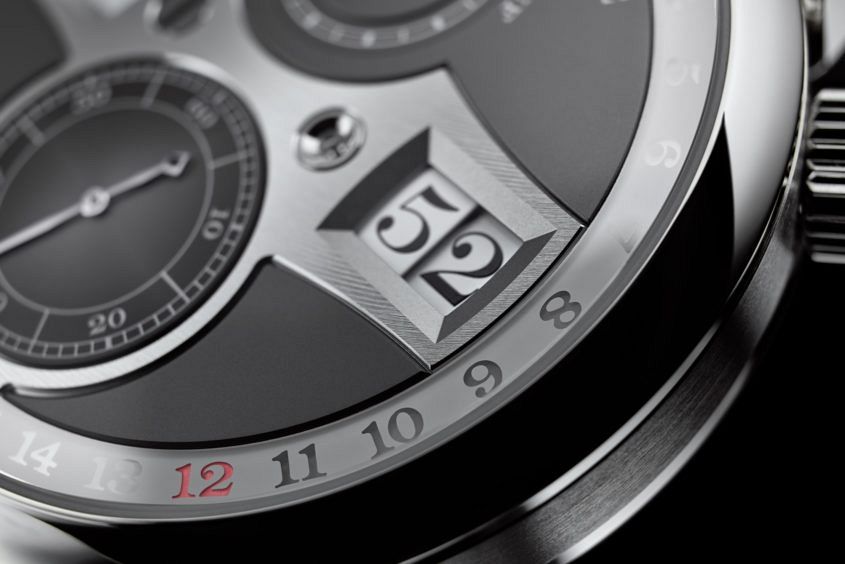 When you think digital watch, the first thing that comes to mind might be a Casio, with a clear digital display, a couple of functions and a light. You don’t think mechanical watch, and you certainly don’t imagine a watch that has its place in the upper echelons of haute horology. But this is exactly what you get with the A. Lange & Söhne Zeitwerk Date, a watch with a clear digital display, and now with an additional function. First released in 2009, the Zeitwerk was a new way to communicate time with a mechanical wristwatch, employing a pair of windows that respectively showed the hours and minutes, read from left to right as you would with any digital display. In an expression of Teutonic symmetry, the running seconds and power reserve are displayed at 6 o’clock and 12 o’clock respectively, giving the unusual dial layout a wonderful symmetry and sense of precision (a broader precision discussed at length here). A decade later, the Zeitwerk gets more complex, now with a date function. While this may seem a relatively trivial addition, the layout of the dial meant adding a date window would disrupt the design, wherever it was placed. The…
 Editor’s note: Many executives in the Swiss watch industry are boring. They went to finance school, and they sell watches by looking at a balance sheet, never finding any of the watches in their own catalogue inspiring, and therefore never inspiring anyone to buy one. This could not be further from the truth for Edouard Meylan, the CEO of H. Moser & Cie. In this interview he gives a crash course on start-up marketing in the watch world (where interesting strategies have come to life recently), and discusses why he was once waiting for legal letters from Apple. It’s both reassuring and alarming to discover that H. Moser & Cie. CEO Edouard Meylan is a human version of his brand’s watches: he is stylish, sophisticated, smart (more on that later) and in possession of a sense of humour that is never too far from the surface. He’s also refreshingly direct and far from complacent about the favourable position he currently finds himself in. All of which adds up to a boss who’s well placed to bring the old, established name of Moser back into the spotlight. I sat down with Edouard in Sydney yesterday, and received a crash course in brand-building 101 from the…
 With a name that sounds like it comes straight from the Marvel Cinematic Universe, it should come as no surprise that the watch looks more than a little out of this world. First of all there’s the dial — or rather the lack of it. Because as you might guess with a name like “Skeleton X”, the dial of this watch is pretty extensively open-worked, offering the wearer a beautifully worked gear train, as well as a whole lot of negative space. The bridges — slight as they may be — form the ‘X’, around a box-like aperture, with the bottom and top aspects of the X framing the escapement and power barrel respectively. This is a thoroughly modern take on a classically skeletonised watch. And while the architecture is aggressive enough, it’s got nothing on the case, which is made from a material called Carbonium. You don’t need to be a particularly cunning linguist to work out that carbon fibre plays an important role in this material. And by the same token, you need not be the most observant fellow to ascertain that this carbon is riddled with gold inflections. It’s a cutting-edge technical material, lightweight and hard-wearing, with a…
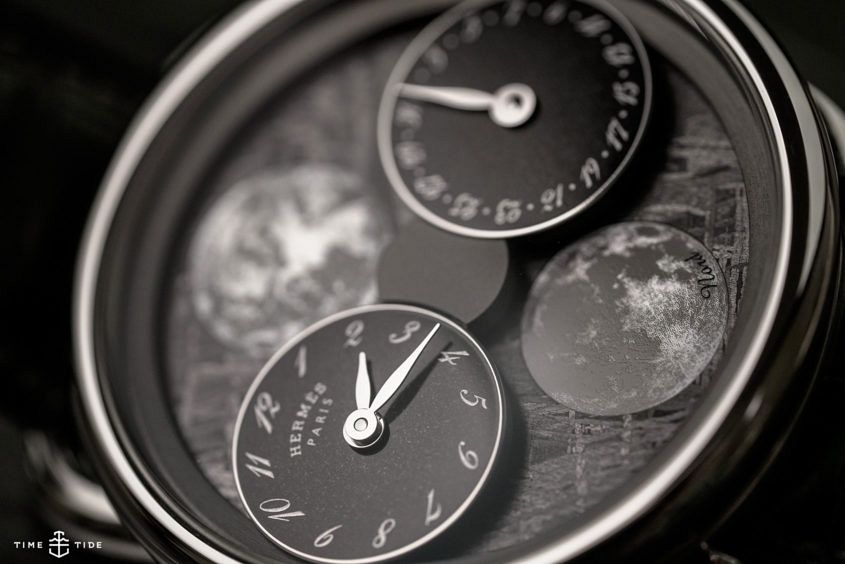 There’s an inherent romance in all mechanical wristwatches — a romance drawn largely from the fact that these painstakingly created devices are fundamentally anachronistic machines that have been superseded several times over. Yet, still they manage to survive and, indeed, thrive. And it might just be me, but this romance factor is more present than ever when it comes to watches with celestial complications because — and let’s be real here — no one *needs* a moonphase in 2019. This fact is why the people who design and create this very traditional complication tend to show a bit of creative license. Such license was the name of the game in the montres department of the grand maison Hermès when they created the Hermès Arceau L’heure de la lune, which offers not one, but two moon phases (southern and northern hemispheres, don’t you know). You see, rather than moving the moons around the dial, Hermès have made the dials do the work. The time and date subdials sit above the base dial (of either meteorite or aventurine, two appropriately celestial materials) and, over the course of a month (or 28.5 days if you’re a pedant) revolve around the dial, obscuring or…