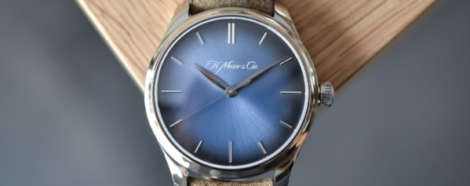
Hands-on – H.Moser & Cie. Endeavour Centre Seconds Automatic: a Simply Perfect 3-Hand Watch?
It’s always a little daunting to review a simple 3-hand dress watch because, on the whole, they tend to steer on the side of ‘conservative, classic, understated elegance’ and can have you thumbing through your Thesaurus in search of yet another way to express ‘conservative, classic, understated elegance’. Luckily, when it comes to H.Moser & Cie., things are different. Although the Endeavour Centre Seconds Automatic is Moser’s simplest 3-hand dress watch and is the brand’s interpretation of a ‘classic in the making’, it speaks a far more contemporary language than many of its peers, more in-tune with the times and the brand’s pervasive philosophy. The two watches we are looking at today – one in red gold and the other in white gold – might be related but the attitude they transmit couldn’t be more different.
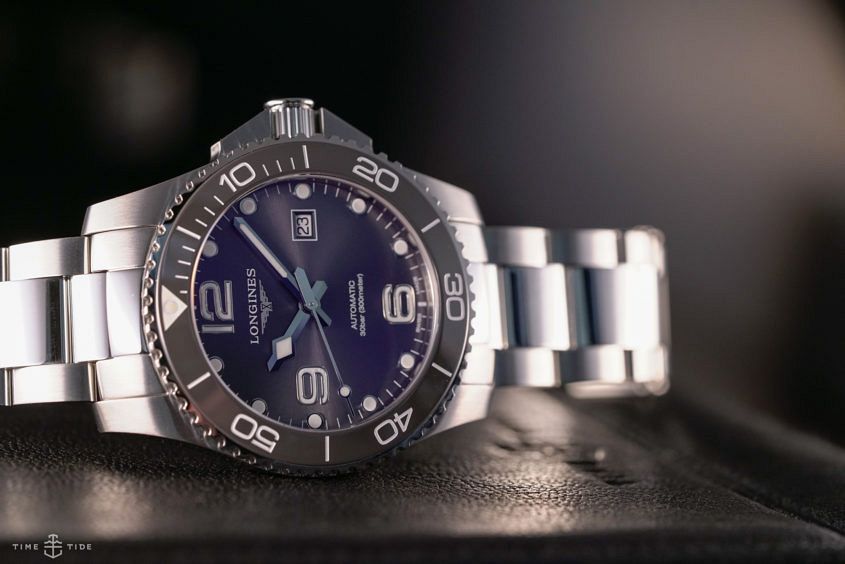 If we’re guilty of one thing when it comes to Longines watches here at Time+Tide, it’s that we maybe focus a little too hard on their heritage heat. It’s something that Andrew realised a while back when he explored their outstanding Master collection, and it’s something I realised at Basel when I saw the latest generation HydroConquest. Yup, the Longines HydroConquest was the recipient of a pretty serious upgrade in 2018, making the sporty line a serious contender in its price point. This diver, offered as an automatic in 43 and 41mm case sizes, comes in a few flavours: black, blue or this new option — grey. Aside from the colourway, the big change here is the bezel, offered now in shimmering ceramic, which is very well matched to the sunray dial. But the material isn’t the only change to the bezel. It looks a bit sleeker, with simple hash marks and 10-minute interval numbers instead of the numbers, broad marks and minute dots of the outgoing design. The dial is a little simpler, too — the date and oversized numerals at the cardinal points are still there, but the dot-plus-hour-marker layout has been simplified to just dots. From the front…
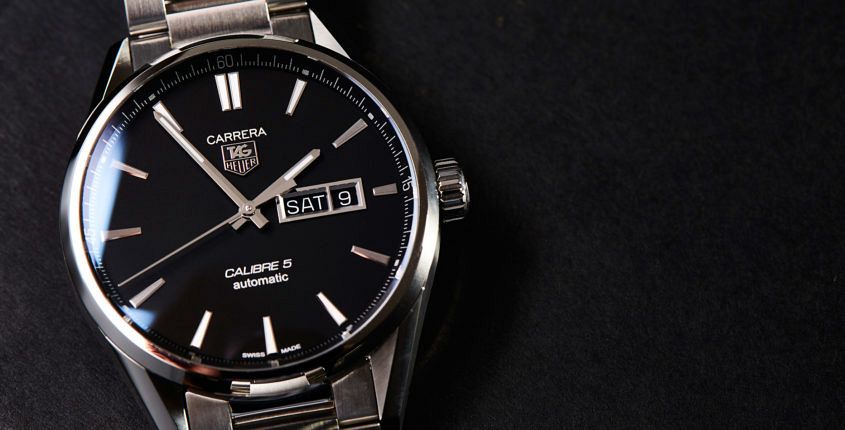 It’s easy to think of the Carrera as purely a collection of chronographs, as that complication is where its roots and, indeed, heart lies. But for a long time the Carrera has been about more than just sports timers. It’s evolved into something more, a shorthand for sports pedigree and precision. This is the spirit with which the Carrera Calibre 5 Day-Date shines. The Carrera look is still there, of course, notably in the 41mm steel case, with those proud lugs and polished bezel. But the heritage is there in the dial — the simple baton markers and matchstick hands aren’t too far off those of the earliest Carreras. What’s new, though, is the day-date apertures: large, legible and neatly framed. Honestly, I really like this sort of execution of dates. They cop a lot of flak when they’re done in a haphazard, last-minute manner, but that is most definitely not the situation here, where the supremely practical calendar info is king, standing out from the matt black dial in a good way. This Carrera is a classical beauty, and the day-date doesn’t detract in the slightest. It’s also a watch built for the everyday. It feels comfortable and solid on the…
 When I talk with other women about watch collecting, the most common reaction runs along the lines of, “Oh, that’s just a sad guy thing” or “I totally don’t get why my husband bought such an expensive one/has to own so many/is so geeky about them …” Or even, “Ha! Boys’ toys – you know what they’re a substitute for …” So yeah, a luxury watch is really just a much more portable version of a muscle car or a mid-life Harley-Davidson. Compensation. For something. Sure, it’s also “a reward for all those years of hard work”. But, in truth, that watch/car/bike is a grown-up security blanket. And, as Linus knows, it’s hard for a guy to live without one. OK, so I’m heading deep into cultural/gender stereotyping territory here. But there’s science and study to back it up – from the seriously academic (Cambridge Professor Simon Baron-Cohen) to the pop psychology of John Gray’s Men Are from Mars, Women Are from Venus. (And let me say it now: I do know watch-guys to whom very little of the following applies. You know who you are.) So, how can watches be a cure for insecurity? Let’s break it down ……
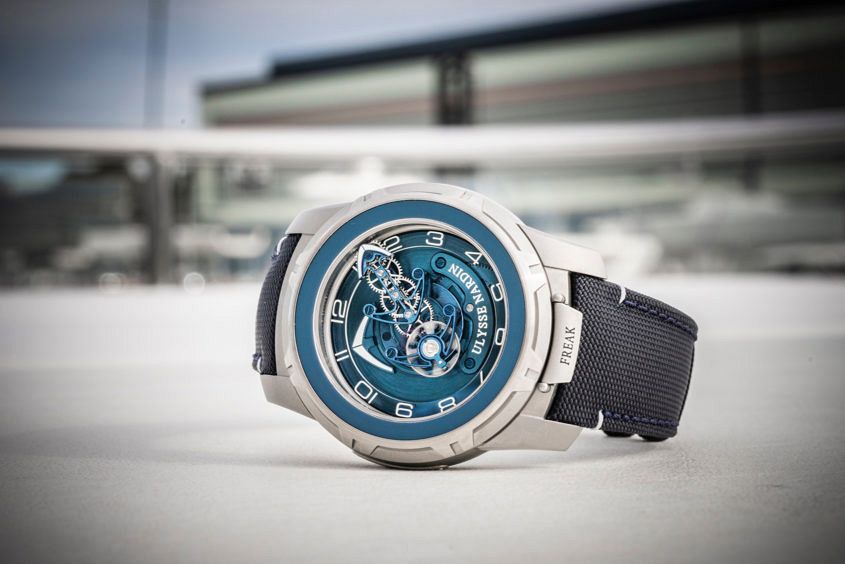 Ulysse Nardin recently introduced four new members of its freaky family. With titanium cases and unmistakable style, these watches are known collectively as the Freak Out, and today we’re taking a look at the Freak Out Blue. First, though, a quick primer on the Freak. Conceived by genius watchmaker Ludwig Oechslin, the Freak first came to life in 2001. It shocked not just because of its unconventional use of a flying carousel tourbillon to tell the time instead of hands, but also its groundbreaking use of silicon components. Fast forward to today and the Freak is, for all its familiarity, still capable of shocking. SIHH saw the entrance of the first automatic Freak, the Freak Vision, and now this quartet joins the fray. Powered by the manually wound UN-205, the observant among you might also have noticed that the Freak Out lacks a traditional crown — instead, the time is set using the newly redesigned bezel (which is unlocked by the lever marked with ‘Freak’ text). Winding is achieved via a similar bezel on the caseback (not that you’ll have to do it too often, thanks to the seven days of power reserve). The real pleasant surprise, though, is the…