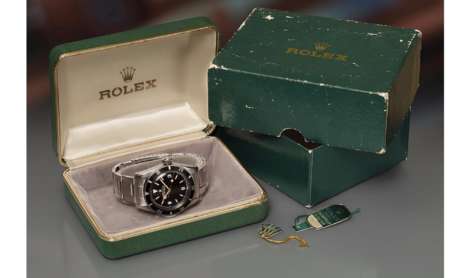
Friday Live: With Paul Boutros From Phillips Auction House With Highlights From Winning Icons
Oh, and Paul Newman’s Paul Newman.
Oh, and Paul Newman’s Paul Newman.
A new GMT timepiece from Ball Watches, with their signature always-on tritium dial.
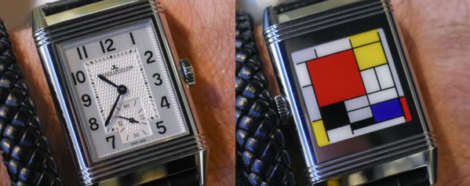
The Reverso certainly is the most iconic watch of Jaeger-LeCoultre. Of course, most of us know its long and rich history, with its roots linked to British polo players asking for a protected watch and its subsequent creation in 1931. There’s one thing that this particular construction allowed: personalisation. Today, the back of this classical Jaeger-LeCoultre Reverso is a field of expression to celebrate a double centenary: the birth 100 years ago of Dutch art school De Stijl (think Piet Mondriaan) and of Dutch retailer Steltman. Here is the specifically-adorned Reverso Tribute to Piet Mondriaan.
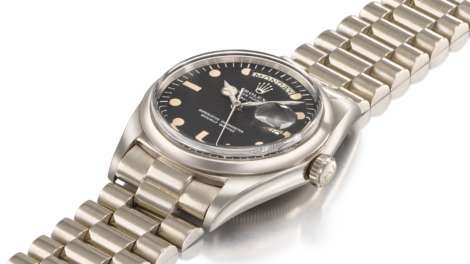
Just when you thought you had seen it all, these two guys show up.
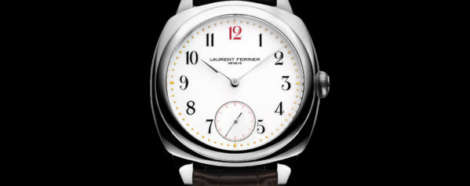
Since its inception in 2010, the brand Laurent Ferrier and its signature watch, the Galet, have always been favourites of ours, here at Monochrome. The reasons for that are simple: the design, the elegance, the execution and mainly, the beauty of the movements. Over the years, the collection has seen some evolutions, the most significant …
 First things first, what is sapphire crystal? Essentially, it’s the same stuff used to make a watch ‘glass’ and display casebacks, formed by crystallising aluminium oxide at very high temperatures to create an extremely hard material. Roughly speaking, it mimics what Earth has taken 400 million or so years to do, to form natural sapphire gemstones. For sapphire-cased watches, the middle, bezel and back are milled from solid blocks of the material. Because it’s almost as hard and scratch-resistant as diamond (9 on the Mohs scale, as opposed to 10 for diamond), the task of milling it into the complex shapes required is much more easily said than done. Indeed, sapphire crystal can be cut only by diamond. Harnessing the knowledge it gained from developing a milling technique for Magic Gold (another hugely challenging material), Hublot works with a Swiss specialist as part of an exclusive partnership to develop the sapphire material. Speaking at Baselworld 2016, Ricardo Guadalupe, Hublot’s CEO, said that the rationale for using the material was to show off its in-house calibres – and that would also determine the choice of models that would be given sapphire cases. 1. 2016 MP-05 LaFerrari After 18 months of development…
The post LIST: Ultimate transparency — Hublot’s sapphire evolution, in 13 watches appeared first on Time and Tide Watches.
First things first, what is sapphire crystal? Essentially, it’s the same stuff used to make a watch ‘glass’ and display casebacks, formed by crystallising aluminium oxide at very high temperatures to create an extremely hard material. Roughly speaking, it mimics what Earth has taken 400 million or so years to do, to form natural sapphire gemstones. For sapphire-cased watches, the middle, bezel and back are milled from solid blocks of the material. Because it’s almost as hard and scratch-resistant as diamond (9 on the Mohs scale, as opposed to 10 for diamond), the task of milling it into the complex shapes required is much more easily said than done. Indeed, sapphire crystal can be cut only by diamond. Harnessing the knowledge it gained from developing a milling technique for Magic Gold (another hugely challenging material), Hublot works with a Swiss specialist as part of an exclusive partnership to develop the sapphire material. Speaking at Baselworld 2016, Ricardo Guadalupe, Hublot’s CEO, said that the rationale for using the material was to show off its in-house calibres – and that would also determine the choice of models that would be given sapphire cases. 1. 2016 MP-05 LaFerrari After 18 months of development…
The post LIST: Ultimate transparency — Hublot’s sapphire evolution, in 14 watches appeared first on Time and Tide Watches.
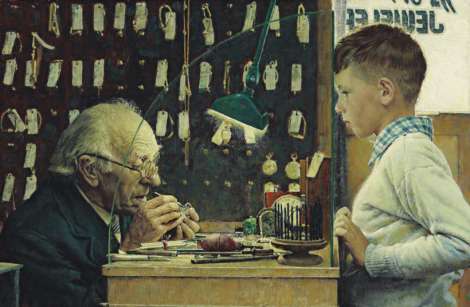
The famous painting will be offered as part of Christie’s November 2017 American Art auction.
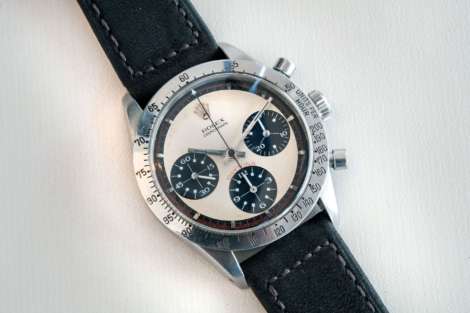
It’s here.
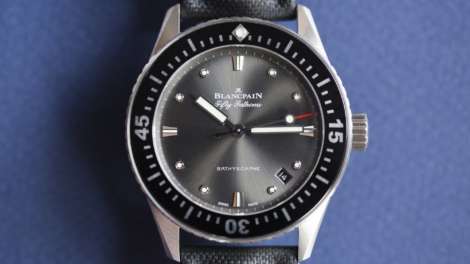
A vintage-inspired diver in a more vintage-inspired size.