HANDS-ON: One simple word that makes the Longines Record a big deal
 Here at Time+Tide we make no bones about being greatly enamoured of Longines’s heritage offerings, so it’s understandable that we made a beeline for the Lindbergh and 1945 models. However, our attention was rapidly drawn to the comparatively pared-back Record, which intrigued us with one simple word on its dial – ‘chronometer’. Now, in case you’re not up with your watch jargon, a chronometer is a essentially a very precise and accurate timepiece. And while in the past the task of certifying chronometers fell to astronomical observatories, these days it’s the duty of Contrôle Officiel Suisses des Chronomètres, Switzerland’s chronometer testing institute. COSC conducts extensive testing of uncased movements over a period of 15 days, ensuring that they achieve an average daily rate of -4/+6 seconds in five positions and at three different temperatures. Some brands, notably Rolex and Breitling, submit all their watches for chronometer certification, but this is the first time Longines has released an entirely COSC-certified collection. The movements that meet this standard are produced by ETA exclusively for the brand, and incorporate a crystal-silicon balance spring. That Longines has committed to this level of accuracy at their competitive price point is impressive, to say the least. So that’s…
The post HANDS-ON: One simple word that makes the Longines Record a big deal appeared first on Time and Tide Watches.

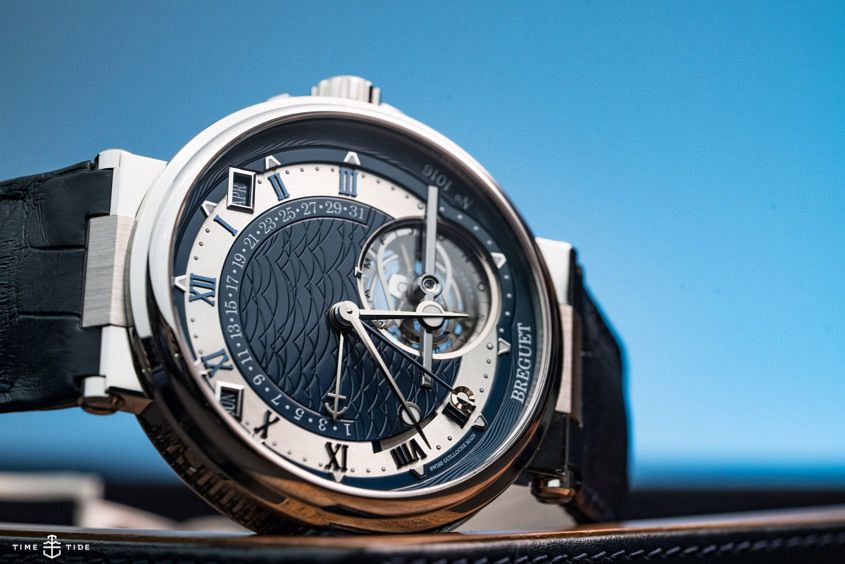 Breguet may not have had the largest collection on display at Basel, but they certainly had one of the most complex. As well as some handsome new additions to the Classique family, Breguet released an epic new grand complication – the Marine Équation Marchante 5887, a completely new watch boasting a perpetual calendar, tourbillon power reserve and, wait for it… a running equation of time. What’s that, I hear you ask? Well, you’ll have watch the video and find out.
 Seiko’s Prospex series of professional dive watches is renowned for two things: its exceptionally high quality-to-value ratio and its large number of passionate fans. And while there are a few perennial standouts in the Prospex family, some parts of the collection ebb and flow based on style and popularity. One such model is the so-called ‘Samurai’, a contemporarily styled 200m diver produced for a few years from 2004. Released in a range of dials variants, and in steel or titanium cases, the watch earned its moniker because the handset reminded wearers of the distinctive angles of the aforementioned warriors’ swords. Also, it’s an unwritten rule that wherever possible, Seiko model nicknames need to explicitly evoke their Japanese origins. As is so often the case with discontinued models, the Samurai developed something of a cult following, and prices for pre-owned models started, slowly but surely, to rise. So when Seiko announced at Baselworld earlier this year that the Samurai was back as a complete collection, it’s only slightly hyperbolic to say that the people rejoiced. Certainly people who care about well-priced, no-nonsense watches (which it turns out is quite a few) were pretty happy. That’s the backstory, so how about the watch?…